
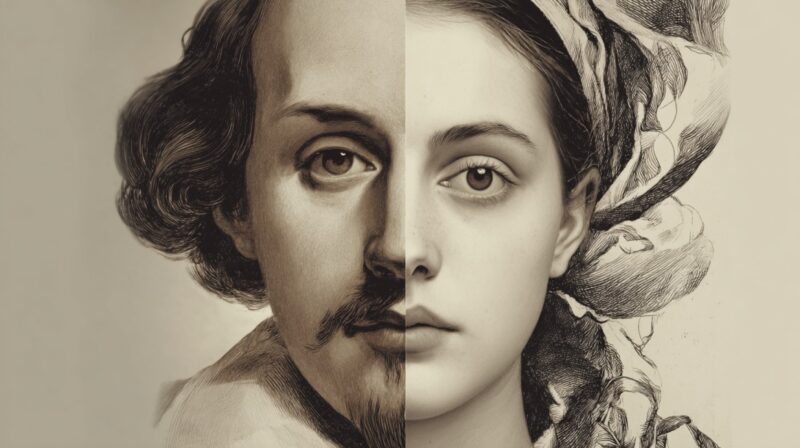
What if one of history’s most celebrated writers was not who readers have long believed, but instead a woman whose brilliance required concealment behind a male name? Such a question has fueled authorship debates for centuries and continues to provoke strong reactions among scholars and readers alike.
Claims surrounding Shakespearean authorship propose that works credited to William Shakespeare may have originated with another writer, possibly a woman barred by social convention.
Mary Sidney, Countess of Pembroke, emerges as a compelling candidate due to her education, access, and literary output. Examination of biographical parallels, textual evidence, and gender politics of early modern England reveals a speculative yet provocative challenge to traditional literary history.
The debate surrounding Shakespearean authorship has endured more than four centuries, gaining renewed attention through feminist scholarship.
Recent discussions increasingly consider women such as Mary Sidney and Emilia Bassano, while arguments stress that historical bias has shaped assumptions about genius and authorship.
Traditional Narrative and Authorship Doubts
@strandbookstore Happy #pubday to SHAKESPEARE WAS A WOMAN AND OTHER HERESIES by #ElizabethWinkler She will be at the Strand on May 15 at 7PM in coversation with #AndreAciman author of #CallMeByYourName Tickets @ strandbooks.com/events #shakespeare #cmbyn #booktok #books #bookstore #strandbookstore #book #bookworm #bookish #bookclub ♬ original sound – Strand Bookstore
William Shakespeare entered the historical record as a man born in Stratford-upon-Avon in 1564, later marrying Anne Hathaway and fathering three children.
Professional activity placed him inside London’s theatrical world during a period of rapid dramatic growth.
Records describe involvement not only as a writer but also as a businessman tied to performance venues and acting companies. Surviving documentation associates his name with multiple aspects of early modern theater.
- Shareholding status in the Globe Theatre indicates sustained engagement with commercial drama.
- Narrative poems such as Venus and Adonis and The Rape of Lucrece circulated publicly under his name during his lifetime.
- References in Willobie His Avisa suggest contemporary recognition as a poet.
- Publication of the First Folio in 1623 frames him as the acknowledged author of the collected plays.
Legal documents, property transactions, and provisions listed in his will confirm the existence of a man actively involved in the theatrical enterprise. Such records form the foundation of the conventional Shakespeare biography taught and accepted for generations.
Reasons Doubt Continues
Skepticism persists due to inconsistencies and absences within the historical record. Biographical gaps leave extended periods undocumented, especially the so-called lost years.
No surviving manuscripts, letters, or personal library records exist, a fact critics find difficult to reconcile with the intellectual range displayed in the plays.
- Lack of evidence detailing advanced education in languages central to the plays.
- Absence of written traces expected of a prolific literary figure.
- Frequent references to aristocratic customs, foreign travel, law, and court politics within the texts.
Hyphenated uses of the name “Shake-speare” in early publications raise further questions. Some readers interpret that spelling as a signifier rather than a surname, suggesting a literary persona rather than a literal identity.
Mastery of Latin, Greek, Italian, and French also prompts doubt about the adequacy of schooling available to a Stratford grammar student.
Mary Sidney

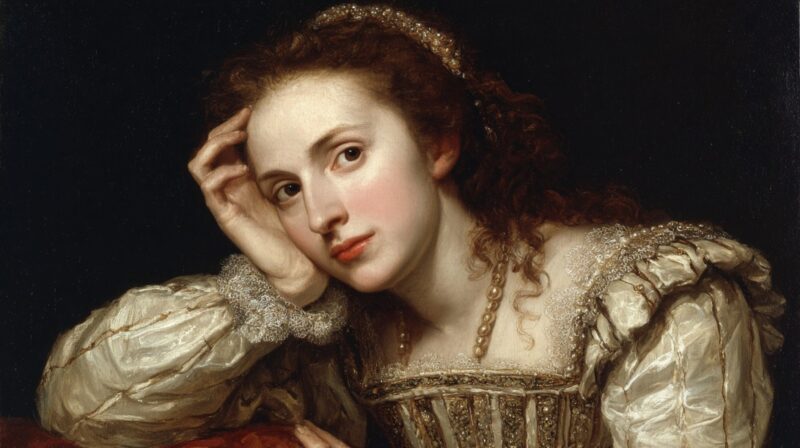
Mary Sidney was born in 1561 into an elite family deeply embedded in English political and literary culture. Status as sister to Sir Philip Sidney placed her within one of the most influential intellectual circles of the Elizabethan court.
Formal education exceeded norms for women of the era and extended across classical and biblical languages.
- Service within Queen Elizabeth’s household provided sustained exposure to diplomacy and court ceremony.
- Wilton House functioned as a center of literary exchange attended by prominent writers.
- Translation of the Psalms demonstrated technical skill and poetic command.
- Original verse circulated within educated circles.
Early contact with theatrical practices strengthens arguments for her involvement with drama. Engagement with acting and writing challenged expectations imposed on noblewomen. Ownership and management of a private acting company further indicate practical experience with stage production.
Knowledge associated with Shakespeare’s works aligns closely with her documented interests. Familiarity with medicine, law, music, politics, and aristocratic behavior appears repeatedly in the plays.
Participation in hunting, hawking, and intellectual pursuits traditionally reserved for men complicates assumptions about female limitation during the period.
The Mary Sidney Theory
Supporters of Mary Sidney’s authorship point to convergences between her life experiences and thematic concerns present in Shakespearean drama. Courtly intrigue, political caution, and elite social dynamics appear with precision in the plays.
Advocates argue such accuracy reflects lived familiarity rather than imaginative imitation.
- Intimate knowledge of court politics is consistent with her upbringing and service.
- Female characters are portrayed with emotional complexity and rhetorical authority.
- Dedication of the First Folio to her sons, the Herbert brothers, suggesting a family role in the preservation of the texts.
Passages expressing frustration, constraint, and suppressed anger resonate strongly with female experience under patriarchal norms. Such moments encourage speculation about a woman’s voice shaping the narratives.
Feminist readings focus on characters who resist imposed roles. Lady Macbeth, Beatrice, Rosalind, Emilia, and Isabella speak openly about power, injustice, and autonomy.
Depth and consistency across these portrayals prompt reconsideration of assumptions surrounding male authorship.
Critiques and Counterarguments
The debate surrounding Mary Sidney as a possible author of Shakespeare’s works provokes some of the strongest reactions within literary scholarship.
Opposition does not arise only due to disagreement with conclusions, but also due to concern about methodology, standards of proof, and preservation of established historical frameworks.
Critics argue that authorship studies risk replacing evidence-based research with imaginative reconstruction when documentary gaps are filled with inference.
Resistance also reflects broader anxiety about destabilizing a literary figure deeply embedded in cultural identity. Shakespeare functions not only as a writer but as a symbol of national and intellectual heritage.
Challenges to that figure often meet heightened scrutiny, especially when they question long-standing assumptions about gender and genius.
Scholarly Rejection
Academic consensus continues to reject Mary Sidney as the author due to a lack of direct documentary evidence. No surviving letters, contracts, diaries, or eyewitness testimony explicitly associate her with Shakespeare’s plays.
Historians trained in archival methods prioritize such materials, and the absence of documentation carries decisive weight.
Skeptics argue that patterns cited by proponents depend heavily on interpretive reasoning rather than verifiable records.
- Symbolic interpretation replaces material evidence, allowing meaning to be inferred rather than demonstrated.
- Hyphenated spellings of “Shake-speare” receive disproportionate interpretive importance compared to broader naming conventions of the period.
- Reasoning patterns resemble conspiracy logic, relying on hidden signals rather than open attribution.
Additional criticism targets readings of Shakespeare’s grave inscription, jokes about literacy, or puns embedded in early texts.
Many scholars view such interpretations as speculative leaps unsupported by historical context. Without corroborating documents, such arguments fail to meet conventional academic thresholds for proof.
Academic Bias

Advocates of feminist revision argue that rejection cannot be separated from institutional bias. Literary authority has long rested with traditions shaped by male scholars, many of whom inherit assumptions about authorship, education, and intellectual capacity.
Resistance to alternative candidates often reflects loyalty to established narratives rather than neutral evaluation.
Power dynamics play a central role in shaping literary history. Questions arise about who determines legitimacy and whose voices gain recognition. Authorship debates expose how standards of proof may shift when challenges originate outside dominant frameworks.
Virginia Woolf once argued that social conditions made female authorship of Shakespeare impossible. That assertion influenced generations of scholars, reinforcing the idea that genius required freedoms denied to women.
Contemporary critics increasingly challenge that view by pointing to aristocratic education, courtly networks, and forms of creative labor available to women like Mary Sidney.
Discomfort surrounding reassessment of authorship reveals anxiety tied to destabilizing male-centered canons. Reconsideration threatens not only attribution but also assumptions about creativity, authority, and historical memory.
Summary
Arguments supporting Mary Sidney lack conclusive evidence yet offer a persuasive alternative narrative grounded in biography, literary skill, and cultural context.
Life experiences and education align closely with the demands of Shakespearean drama. Reflection on such theories underscores the persistent marginalization of women writers.
Reconsideration of Mary Sidney enriches discourse about authorship, gender, and historical memory, even if certainty remains elusive.