
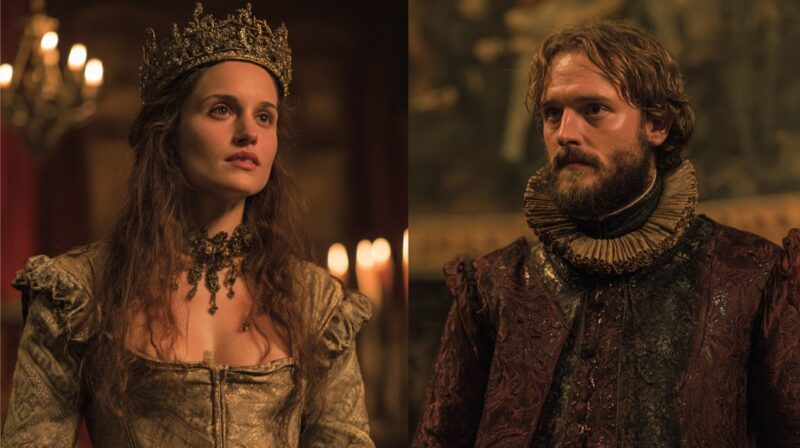
Shakespeare remains cinema’s most adapted writer, shaping film and television across decades through faithful recreations and bold modern reinterpretations. Filmmakers continue to revisit his stories because themes of love, ambition, jealousy, betrayal, and power never lose relevance.
Interest surged again in 2026 after the release of Hamnet, prompting audiences to return to screen adaptations that translate Shakespeare’s work into contemporary cinematic language.
Streaming platforms play a central role in keeping these stories visible, accessible, and culturally active. Netflix and HBO offer a wide range of adaptations that reshape Elizabethan drama into rom-coms, noir tragedies, teen comedies, and genre hybrids.
Choices include direct adaptations and modern reinterpretations that earned strong critical response or major commercial success. Genre variety matters, spanning romance, tragedy, comedy, teen films, fantasy, and genre-bending experiments.
1. The Tragedy of Macbeth (2021) on HBO Max
- Release year: 2021
- Director: Joel Coen
- Lead performances: Denzel Washington, Frances McDormand
- Supporting role of note: Corey Hawkins as Macduff
Joel Coen reimagines Macbeth as a stripped-down psychological nightmare driven by shadow, silence, and moral decay.
Stark black-and-white cinematography removes historical comfort and places focus on internal collapse.
Minimalist sets resemble a void rather than a castle, trapping characters inside ambition and paranoia. Violence feels inevitable rather than sensational, reinforcing the sense of fate closing in.
Denzel Washington portrays Macbeth as exhausted and desperate rather than reckless, shifting the tragedy toward psychological erosion.
Frances McDormand delivers Lady Macbeth with controlled intensity, allowing guilt to seep through restraint instead of theatrics.
Visual restraint sharpens tension, forcing attention onto spoken word and facial expression rather than spectacle.
2. 10 Things I Hate About You (1999) on Netflix
@netflix the best way to let u know that #10ThingsIHateAboutYou ♬ original sound – Netflix
- Release year: 1999
- Director: Gil Junger
- Principal cast: Heath Ledger, Julia Stiles, Joseph Gordon-Levitt
“10 Things I Hate About You” follows high school corridors that replace Renaissance courts in this modern take on The Taming of the Shrew.
Sharp dialogue and character-driven humor turn Shakespeare’s verbal sparring into teenage rebellion, insecurity, and desire.
Emotional honesty keeps the romance grounded even as comedy leans playful and self-aware.
Heath Ledger’s charisma reshaped romantic comedy archetypes, while Julia Stiles brought intelligence and vulnerability to a role built on resistance.
Writing balances humor with sincerity, allowing character growth to feel earned rather than imposed. Cultural memory endures because relationships evolve through conversation rather than gimmick.
3. Romeo + Juliet (1996) on HBO Max
- Release year: 1996
- Director: Baz Luhrmann
- Lead actors: Leonardo DiCaprio, Claire Danes
Baz Luhrmann injects kinetic energy into Romeo and Juliet through rapid editing, saturated color, and contemporary iconography.
Gunfights replace swordplay, yet Shakespeare’s language remains intact, creating friction between classical dialogue and modern imagery.
Soundtrack choices push emotion forward at full volume.
Leonardo DiCaprio channels impulsive passion, while Claire Danes brings emotional clarity to Juliet. Academic circles continue to revisit the film due to its daring formal approach and influence on youth-oriented adaptations.
Visual excess supports emotional urgency rather than overwhelming it.
4. Othello (1995) on HBO Max
- Release year: 1995
- Director: Oliver Parker
- Othello portrayed by: Laurence Fishburne
- Iago portrayed by: Kenneth Branagh
Oliver Parker’s adaptation of Othello centers tension on intimacy and psychological manipulation rather than scale.
Casting Laurence Fishburne as Othello marked a historic shift in mainstream Shakespeare cinema. Emotional vulnerability replaces heroic distance, making betrayal feel personal and immediate.
Kenneth Branagh’s Iago operates with quiet calculation, weaponizing trust rather than force. Race and jealousy intersect without simplification, allowing motives to remain unsettlingly human.
Scenes unfold with mounting unease as control tightens gradually rather than erupting suddenly.
5. Warm Bodies (2013) on Netflix
@lionsgateuk communication choice: n/a #warmbodies #filmtok ♬ original sound – Lionsgate UK
- Release year: 2013
- Director: Jonathan Levine
- Central performances: Nicholas Hoult, Teresa Palmer
Post-apocalyptic comedy reshapes Romeo and Juliet into a story where love literally restores life.
Zombies roam a ruined society, yet tone favors warmth over horror. Humor softens bleakness without erasing emotional stakes.
Nicholas Hoult plays a muted, introspective Romeo figure whose internal monologue replaces Shakespearean soliloquy.
Teresa Palmer’s Juliet brings optimism without naivety.
Romance functions as a healing mechanism, pushing transformation across both personal and societal levels.
6. She’s the Man (2006) on HBO Max

- Release year: 2006
- Director: Andy Fickman
- Lead performance: Amanda Bynes, Channing Tatum
Mistaken identity fuels comedy in this reworking of Twelfth Night, shifting gender disguise into a competitive school sports setting.
Fast pacing and physical humor support themes of self-expression and fairness. Emotional confusion grows organically through deception rather than coincidence.
Amanda Bynes anchors the film with energy and comedic precision, balancing slapstick with vulnerability.
Gender roles receive playful interrogation through athletic competition and romantic tension. Humor lands without undermining sincerity, allowing identity struggles to resonate beneath comedy.
7. Much Ado About Nothing (1993) on HBO Max
@pedropascalispunk75 Pedro in Much Ado About Nothing 🫶🏼 #pedropascal #pedropascaledit #pedropascaltiktok #pedropascaldaily #pascalispunk #shakespeare ♬ original sound – Pedro Pascal 🧎🏻♀️
- Release year: 1993
- Director: Kenneth Branagh
- Ensemble members: Emma Thompson, Denzel Washington, Keanu Reeves, Michael Keaton
Sunlit visuals and fluid performances define Kenneth Branagh’s adaptation of Much Ado About Nothing.
Verbal sparring takes priority, allowing rhythm and timing to drive humor. Romantic misunderstandings unfold with theatrical clarity rather than cynicism.
Actors often reference the film in educational settings due to clear delivery of language and accessible tone.
A later black-and-white adaptation by Joss Whedon exists in select regions, offering a pared-down counterpoint without altering narrative structure.
8. Anyone But You (2023) on Netflix
- Release year: 2023
- Director: Will Gluck
- Lead actors: Sydney Sweeney, Glen Powell
Modern romantic comedy reframes Much Ado About Nothing as a glossy enemies-to-lovers story set against coastal scenery.
Sharp banter replaces formal verse, yet narrative beats mirror Shakespeare’s romantic misdirection closely.
Sydney Sweeney and Glen Powell generate friction-driven chemistry that sustains momentum. Financial success surpassed all prior Shakespeare-based adaptations, proving classical frameworks still thrive within contemporary romantic formulas.
Subtle references reward attentive viewers without requiring prior knowledge of the play.
Closing Reflections
Shakespeare’s stories continue to thrive because filmmakers keep reshaping them to match contemporary tastes, visual styles, and emotional rhythms.
High school hallways, dystopian wastelands, sunlit villas, and minimalist soundstages all support narratives written centuries ago.
Streaming platforms make these adaptations easy to revisit and rediscover in 2026 on streaming platforms like HBO and Netflix. Availability changes frequently, making timely viewing worthwhile.
Romance, tragedy, comedy, and genre experimentation all prove that Shakespeare still speaks fluently through modern cinema.